
ISBN
Formato digital
979-13-88349-17-1
Fecha de publicación
03-07-2026
Licencia
D. R. © copyright 2026. Francisco Aranda Espinosa.
Todos los contenidos de esta obra se comparten bajo la licencia Creative Commons Atribución/Reconocimiento-NoComercial-CompartirIgual 4.0 Internacional (CC BY-NC-SA 4.0). Esto implica que no está autorizado el uso comercial de la obra original ni de las eventuales obras derivadas, las cuales deberán distribuirse bajo la misma licencia que rige la obra original. No obstante, se permite a terceros compartir el contenido siempre y cuando se reconozca debidamente la autoría y la publicación original en esta editorial.

Autor
Francisco Aranda Espinosa
Universidad Autónoma del Estado de Hidalgo
0000-0002-2582-4431
Acerca de
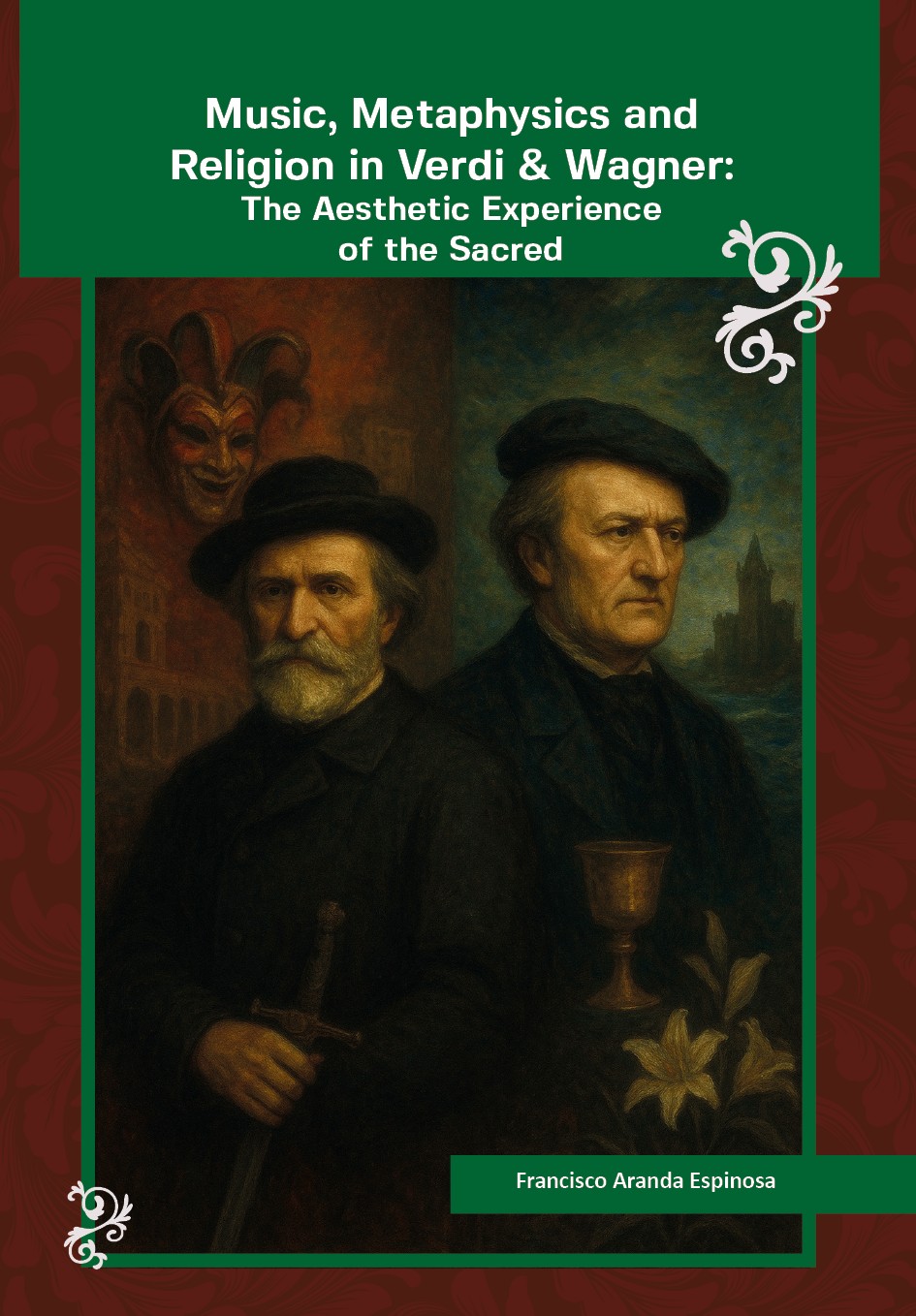
It is safe to assume that anyone who appreciates music and drama is familiar with the operas of Giuseppe Verdi and Richard Wagner. There is also litle doubt that both rank among the most important composers in the history of music. The two were born in 1813: Verdi on October 10 in Le Roncole, a village near Busse-to in the Italian province of Parma, and Wagner slightly earlier, on May 22, in Leipzig, then part of the Kingdom of Saxony. While Verdi died in 1901 at the age of 88 in Lombardy, which borders his native Emilia-Romagna, Wagner passed away suddenly in 1883 at the age of 69, a bit farther from Germany, having spent that summer with his wife, Cosima, the daughter of Franz Liszt, in a beautiful palazzo on Venice’s Grand Canal.
Referencias
Abbate, C. (1993). Unsung Voices: Opera and Musical Narrative in the Nineteenth Century. Princeton University Press.
Abbate, C., & Parker, R. (2015). A History of Opera. W. W. Norton & Company.
Adorno, T. W. (1952/2005). In Search of Wagner (R. Livingstone, Trans.). Verso.
Agamben, G. (2005). The Time That Remains: A Commentary on the Letter to the Romans (P. Dailey, Trans.). Stanford University Press.
Aranda Espinosa, F. (2024). The Musical Subconscious: from Mozart to Rossini, Metamorphosis of a Coloratura, a Compendium of Musical and Psychological Appreciation. European Public & Social Innovation Review, 9, 1–14. Retrieved from https://doi.org/10.31637/epsir-2024-515
Aristotle. (ca. 350 BCE/1994). Poetics (S. H. Butcher, Trans.). The Internet Classics Archive. Retrieved August 23, 2025 from http://classics.mit.edu/Aristotle/poetics.html
Bataille, G. (1967/1988). The Accursed Share. An Essay on General Economy (R. Hurley, Trans.). Zone Books.
Bataille, G. (1954/1988). Inner Experience (L. A. Boldt, Trans.). State University of New York Press.
Benjamin, W. (2003). Theses on the Philosophy of History (H. Eiland & K. McLaughlin, Trans.). In H. Eiland & M. Jennings (Eds.), Walter Benjamin: Selected Writings, Volume 4, 1938–1940 (pp. 389–400). Harvard University Press.
Budden, J. (1973). The Operas of Verdi: Volume 1: From Oberto to Rigoletto. Praeger.
Budden, J. (1992). Verdi. Oxford University Press.
Cervone, R. (Ed.). (1989). Tannhäuser, in Richard Wagner: Tannhäuser [Booklet]. Deutsche Grammophon.
Chéreau, P. (2008). Wann wird es Nacht im Haus? Notes on Tristan in Wagner: Tristan und Isolde [Booklet] (P. Kennedy, Trans.). RAI TRADE/Erato/Warner Classics, Warner Music UK Ltd.
Dostoevsky, F. (1866-1867). Crime and Punishment (C. Garnett, Trans.). Planet.
Eagleton, T. (2003). Sweet Violence: The Idea of the Tragic. Blackwell Publishing.
Foucault, M. (1977–78/2007). Security, Territory, Population: Lectures at the Collège de France 1977–78 (G. Burchell, Trans.). Palgrave Macmillan.
Girard, R. (1923/1989). Violence and the Sacred (P. Gregory, Trans.) The Johns Hopkins University Press.
Gossett, P. (1996). Rigoletto, in Giuseppe Verdi: Rigoletto [Booklet]. EMI Records Ltd.
Hegel, G. W. F. (1807/2018). Phenomenology of Spirit (T. Pinkard, Trans.). Cambridge University Press.
Hegel, G. W. F. (1835–38/1975). Aesthetics: Lectures on Fine Art (T. M. Knox, Trans., Vol. 1 & 2). Oxford University Press.
Jankélévitch, V. (1974). L’irréversible et la nostalgie. Paris: Flammarion.
Kierkegaard, S. (1941). The Sickness unto Death (W. Lowrie, Trans.). Princeton University Press.
Kimbell, D. (1980). Rigoletto, in Giuseppe Verdi: Rigoletto [Booklet]. Deutsche Grammophon.
Murashev.com. (n.d.). Rigoletto Libretto (Italian-English). Retrieved August 8, 2025, from https://www.murashev.com/opera/Rigoletto_libretto_Italian_English
Murashev, D. (n.d.). Tristan und Isolde Libretto (English-German). Retrieved August 12, 2025, from https://www.murashev.com/opera/Tristan_und_Isolde_libretto_English_German
Nietzsche, F. (1872/1999). The Birth of Tragedy and Other Writings (R. Speirs, Trans.). Cambridge University Press.
Nietzsche, F. (1882/1974). The Gay Science (W. Kaufmann, Trans.). Vintage.
Nietzsche, F. (1888/1998). The Case of Wagner: A Musician’s Problem (W. Kaufmann & R. J. Hollingdale, Trans.). Vintage.
O’Connell, C. (1929). The Victor Book of the Opera. RCA Manufacturing Company.
Otto, R. (1923/1936). The Idea of the Holy. An Inquiry into the Non-Rational Factor in the Idea of the Divine and its Relation to the Rational (J. W. Harvey, Trans.). Oxford University Press.
Porter, A. (1971). Don Carlos: Opera in Five Acts [Booklet]. EMI Records Ltd.
Prod’homme, J.-G. (1921). Unpublished letters from Verdi to Camille Du Locle (1866–76). The Musical Quarterly, 7(1), 73–103. Retrieved from https://www.jstor.org/stable/738020
Sadie, S. (Ed.) (1992). The New Grove Book of Operas. St. Martin’s Press.
Schmitt, C. (1922/2005). Political Theology: Four Chapters on the Concept of Sovereignty (G. Schwab, Trans.). University of Chicago Press.
Schopenhauer, A. (1818/1969). The World as Will and Representation (E. F. J. Payne, Trans.). Dover.
Schopenhauer, A. (1818/2020). The World as Will and Idea (R. B. Haldane & J. Kemp, Trans.). Lector House.
Steane, J. B. (1986). Callas and Rigoletto, in Giuseppe Verdi: Rigoletto [Booklet]. EMI Records Ltd.
Vitiello, V. (1995). Cristianesimo senza redenzione. Laterza.
Wagner, R. (n.d.). Tannhäuser Libretto (English & German). Murashev.com. Retrieved August 25 from https://www.murashev.com/opera/Tannh%C3%A4user_libretto_English_German
Wagner, R. (1905). Richard Wagner to Mathilde Wesendonck (W. A. Ellis, Trans. & Ed.). H. Grevel & Co.
Wallis, C. (1986). Verdi and Rigoletto, in Giuseppe Verdi: Rigoletto [Booklet]. EMI Records Ltd.
Weaver, W. (1985). The Trials of Rigoletto. Decca.
Wittgenstein, L. (1921/55). Tractatus Logico-Philosophicus (D. F. Pears & B. F. McGuinness, Trans.). Routledge & Kegan Paul.
Žižek, S. (2008). In Defense of Lost Causes. Verso.
Žižek, S. (2012). Less than Nothing. Hegel and the Shadow of Dialectical Materialism. Verso.