
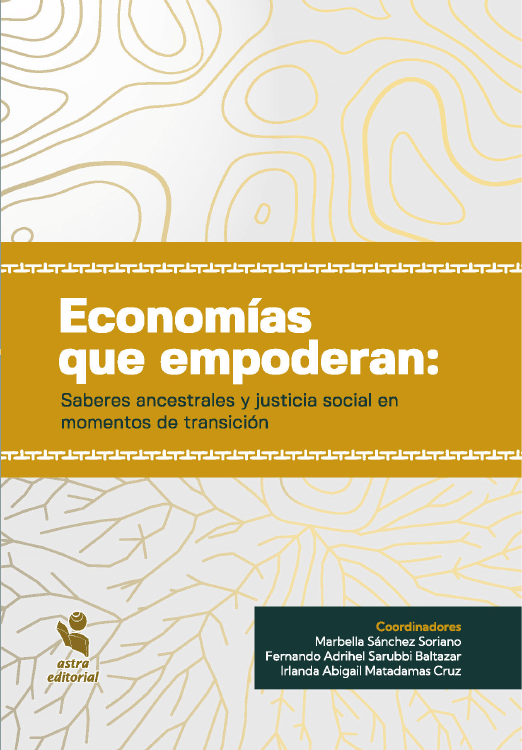
ISBN
Formato digital
979-13-88349-47-8
Fecha de publicación
2026
Licencia
D. R. © copyright 2026. Marbella Sánchez Soriano, Fernando Adrihel Sarubbi Baltazar y Irlanda Abigail Matadamas Cruz
Todos los contenidos de esta obra se comparten bajo la licencia Creative Commons Atribución/Reconocimiento-NoComercial-CompartirIgual 4.0 Internacional (CC BY-NC-SA 4.0). Esto implica que no está autorizado el uso comercial de la obra original ni de las eventuales obras derivadas, las cuales deberán distribuirse bajo la misma licencia que rige la obra original. No obstante, se permite a terceros compartir el contenido siempre y cuando se reconozca debidamente la autoría y la publicación original en esta editorial.

Isabel Ballesteros Palacios
Instituto Tecnológico del Valle de Etla. Área de Gestión Empresarial.
0009-0002-3757-7746
Amairani Marlenne Ruiz Robles
Instituto Tecnológico del Valle de Etla, Área de Desarrollo Comunitario
0009-0004-7359-9680
Cecilia Hernández Ramírez
Instituto Tecnológico del Valle de Etla, Área de Desarrollo Comunitario
0000-0002-8639-0470
Acerca de
El posicionamiento de productos con identidad regional constituye un reto estratégico en mercados competitivos y diferenciados por la digitalización. En este contexto, se analizó el caso TLAYUKIT en el mercado local de Oaxaca, evaluando el reconocimiento, la percepción del consumidor y los factores que influyen en la decisión de compra. Se aplicaron encuestas a consumidores obteniendo como resultando un bajo conocimiento de la marca, limitando su presencia en el mercado, sin embargo al producto se le atribuye fortalezas asociadas a la calidad, identidad regional y diferenciación, con este análisis de enfoque cuantitativo descriptivo y de corte transversal se detectaron áreas de mejora en el diseño del empaque y su presencia en digital, así como la necesidad de implementar estrategias de marketing que relacione herramientas digitales y elemento culturales para su consolidación comercial.
Referencias
Asociación de Internet MX. (2023). Estudio de hábitos de usuarios de internet en México 2023. https://www.asociaciondeinternet.mx
Castillo-Canalejo, A. M., Sánchez-Cañizares, S. M., y Cabeza-Ramírez, L. J. (2021). Food tourism and its impact on sustainable rural development. Sustainability, 13(1), 1–15. https://doi.org/10.3390/su13010045
Chaffey, D., y Smith, P. R. (2022). Digital marketing excellence: Planning, optimizing and integrating online marketing (7th ed.). Routledge.
Chaffey, D., y Ellis-Chadwick, F. (2022). Digital marketing: Strategy, implementation and practice (8th ed.). Pearson.
Chaudhuri, A., Mazumdar, S., y Ghoshal, A. (2022). The role of brand trust and brand experience in building brand equity: A study in emerging markets. Journal of Brand Management, 29(3), 1–15. https://doi.org/10.1057/s41262-021-00267-2
Dwivedi, Y. K., Ismagilova, E., Hughes, D. L., Carlson, J., Filieri, R., Jacobson, J., Jain, V., Karjaluoto, H., Kefi, H., Krishen, A. S., Kumar, V., Rahman, M. M., Raman, R., Rauschnabel, P. A., (2021). Setting the future of digital and social media marketing research: Perspectives and research propositions. International Journal of Information Management, 59, 102168. https://doi.org/10.1016/j.ijinfomgt.2020.102168
Ellis, A., Park, E., Kim, S., y Yeoman, I. (2021). What is food tourism? Tourism Management, 83, 104–215. https://doi.org/10.1016/j.tourman.2020.104215
Feldmann, C., y Hamm, U. (2015). Consumers’ perceptions and preferences for local food: A review. Food Quality and Preference, 40, 152–164. https://doi.org/10.1016/j.foodqual.2014.09.014
Food and Agriculture Organization of the United Nations -FAO (2023). The status of women in agrifood systems. FAO. https://doi.org/10.4060/cc5343en
Grewal, D., Roggeveen, A. L., y Nordfält, J. (2021). The future of retailing in a digital world. Journal of Retailing, 97(1), 1–6. https://doi.org/10.1016/j.jretai.2020.12.001
Guerrero, L., Guàrdia, M. D., Xicola, J., Verbeke, W., Vanhonacker, F., Zakowska-Biemans, S., Sajdakowska, M., Sulmont-Rossé, C., Issanchou, S., Contel, M., Scalvedi, L., Granli, B. S., y Hersleth, M. (2009). Consumer-driven definition of traditional food products and innovation in traditional foods. A qualitative cross-cultural study. Appetite, 52(2), 345–354. https://doi.org/10.1016/j.appet.2008.11.008
Gürel, E., y Tat, M. (2017). SWOT analysis: A theoretical review. Journal of International Social Research, 10(51), 994–1006.
Hernández-Rojas, R. D., Huete-Alcocer, N., y López-Ruiz, V. R. (2023). Cultural branding and gastronomy: Effects on consumer perception. Journal of Destination Marketing y Management, 27, 100757. https://doi.org/10.1016/j.jdmm.2022.100757
Hernández-Sampieri, R., y Mendoza Torres, C. P. (2018). Metodología de la investigación: Las rutas cuantitativa, cualitativa y mixta (1.ª ed.). McGraw-Hill Education.
Keller, K. L. (2013). Strategic Brand Management: Building, Measuring, and Managing Brand Equity (4th ed.). Pearson.
Kotler, P., y Keller, K. L. (2022). Marketing Management (16th Global ed.). Pearson.
Kotler, P., Kartajaya, H., y Setiawan, I. (2021). Marketing 5.0: Technology for humanity. Wiley.
Kotler, P., Keller, K. L., y Chernev, A. (2022). Marketing Management (16th Global ed.). Pearson.
Kranzbühler, A. M., Kleijnen, M. H. P., Morgan, R. E., y Teerling, M. (2020). The multilevel nature of customer experience research: An integrative review and research agenda. International Journal of Management Reviews, 22(4), 433–456. https://doi.org/10.1111/ijmr.12226.
Lemon, K. N., y Verhoef, P. C. (2016). Understanding customer experience throughout the customer journey. Journal of Marketing, 80(6), 69–96. https://doi.org/10.1509/jm.15.0420
López-Roldán, P., y Fachelli, S. (2019). Metodología de la investigación social cuantitativa. Universidad Autónoma de Barcelona.
Lundqvist, A., Liljander, V., Gummerus, J., y Van Riel, A. (2013). The impact of storytelling on the consumer brand experience: The case of a firm-originated story. Journal of Brand Management, 20(4), 283–297. https://doi.org/10.1057/bm.2012.15
Napoli, J., Dickinson, S. J., Beverland, M. B., y Farrelly, F. (2014). Measuring consumer-based brand authenticity. Journal of Business Research, 67(6), 1090–1098. https://doi.org/10.1016/j.jbusres.2013.06.001
Rather, R. A., Hollebeek, L. D., y Rasoolimanesh, S. M. (2022). First-time versus repeat tourism customer engagement, experience, and value co-creation: An empirical investigation. Journal of Travel Research, 61(3), 549–564. https://doi.org/10.1177/0047287520983532
Rosario, A. B., Sotgiu, F., De Valck, K., y Bijmolt, T. H. A. (2016). The effect of electronic word of mouth on sales: A meta-analytic review of platform, product, and metric factors. Journal of Marketing Research, 53(3), 297–318. https://doi.org/10.1509/jmr.14.0380
Solomon, M. R. (2020). Consumer behavior: Buying, having, and being (13th ed.). Pearson.
Testa, R., Galati, A., Schifani, G., Di Trapani, A. M., y Migliore, G. (2019). Culinary tourism experiences in agri-tourism destinations and sustainable consumption: Understanding Italian tourists’ motivations. Sustainability, 11(17), 4588 https://doi.org/10.3390/su11174588.
United Nations Educational, Scientific and Cultural Organization. (2010). La cocina tradicional mexicana: Una cultura comunitaria, ancestral y viva y el paradigma de Michoacán. https://ich.unesco.org/es/RL/la-cocina-tradicional-mexicana-cultura-comunitaria-ancestral-y-viva-el-paradigma-de-michoacn-00400.
Verhoef, P. C., Kannan, P. K., y Inman, J. J. (2021). From multi-channel retailing to omnichannel retailing: Introduction to the special issue on multi-channel retailing. Journal of Retailing, 97(2), 174–181. https://doi.org/10.1016/j.jretai.2021.02.005
Vrontis, D., El Nemar, S., Ouwaida, A., y Shams, S. M. R. (2021). The impact of social media on brand positioning in the digital era. Journal of Business Research, 122, 113–121. https://doi.org/10.1016/j.jbusres.2020.08.034.